
Why Companies Keep Moving Sourcing Out of China—Even When China Still Wins on Price
Every year, procurement teams across consumer products, retail, and manufacturing revisit what has become one of the most persistent questions in global sourcing:
If China is still often the cheapest option, why are companies working so hard to source elsewhere?
It’s a fair question—and one that frustrates many sourcing professionals who have gone through the exercise firsthand.
A company explores Vietnam, Thailand, India, or Mexico hoping to reduce tariff exposure, diversify supply, or cut risk. Months are spent auditing suppliers, comparing quotes, reviewing HTS classifications, and modeling logistics. Then, more often than expected, the conclusion is surprisingly familiar: China still delivers the better overall deal.
Even with tariffs, Chinese suppliers frequently outperform on total landed cost. Pricing is often lower, infrastructure is more mature, supplier ecosystems are denser, and production capacity is difficult to match.
So why does this cycle continue?
Because the real answer has less to do with price today—and far more to do with protecting the business tomorrow.
China Still Dominates for a Reason
China did not become the world’s manufacturing powerhouse by accident.
For decades, companies have relied on China not simply because labor was cheaper, but because the country built an industrial ecosystem that remains extraordinarily difficult to replicate. In many product categories, China offers something competitors still struggle to match: scale.
Raw materials, tooling, component suppliers, packaging, assembly, and export logistics often operate within highly efficient regional clusters. That means fewer operational gaps, shorter production cycles, and lower hidden costs.
China also benefits from supplier density. In mature categories, thousands of factories competing for business naturally compress pricing. Add in world-class ports, experienced export systems, and a deeply established manufacturing culture, and it becomes clear why so many diversification projects eventually hit a wall.
For many consumer product companies, China remains the lowest total landed cost—not necessarily because tariffs don’t matter, but because China’s operational advantages often outweigh them.
This is where many sourcing strategies stall: companies expect tariffs alone to make China uncompetitive, only to realize that supply chain maturity can matter more than duty rates.
So Why Are Companies Looking Beyond China?
Because sourcing strategy has fundamentally changed.
Procurement is no longer just about finding the lowest unit price. It has evolved into a broader discipline centered on resilience, risk mitigation, and strategic flexibility.
In today’s environment, sourcing leaders are not simply asking, “Where is this cheapest right now?”
They are increasingly asking:
“What happens if this supply chain breaks?”
Trade wars, tariff changes, geopolitical tensions, regulatory uncertainty, and pandemic-era disruptions have all exposed the dangers of overdependence on a single country.
This is why “China Plus One” has become such a common strategy.
For many businesses, moving out of China entirely is not the objective. Instead, the goal is to reduce concentration risk by maintaining China as a primary source while developing secondary sourcing options elsewhere.
Vietnam, India, Thailand, and Mexico are often less about immediate savings and more about strategic insurance.
In other words, diversification is often not a replacement strategy—it’s a continuity strategy.
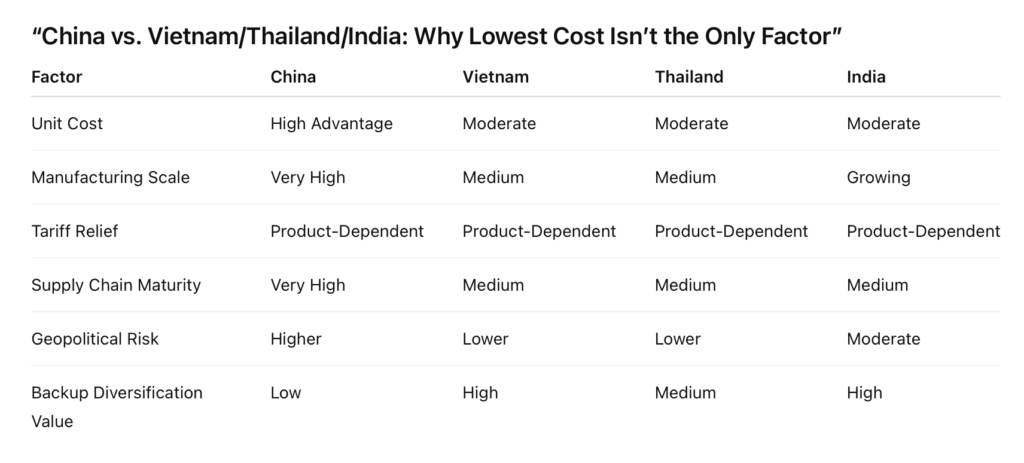
China vs. Vietnam/Thailand/India: Why Lowest Cost Isn’t the Only Factor
Tariffs Are Only One Variable—Not the Whole Equation
One of the biggest misconceptions in procurement is the assumption that moving production out of China automatically creates tariff relief.
In reality, tariff outcomes depend heavily on HTS codes, product classifications, country-of-origin rules, and broader trade frameworks. For many categories, relocating production may offer little or no meaningful tariff advantage.
This often surprises companies that expected relocation to create automatic savings.
More importantly, tariffs are only one line item in a much larger financial equation.
True sourcing decisions require evaluating total landed cost, which includes not only duties, but also freight, lead times, supplier maturity, quality consistency, tooling investment, compliance oversight, inventory carrying costs, and operational risk.
This is where procurement teams often make costly mistakes.
A supplier may offer a lower FOB price—or a lower tariff profile—while introducing greater hidden costs through delays, compliance failures, or production inconsistency.
The cheapest quote is not always the cheapest business decision.
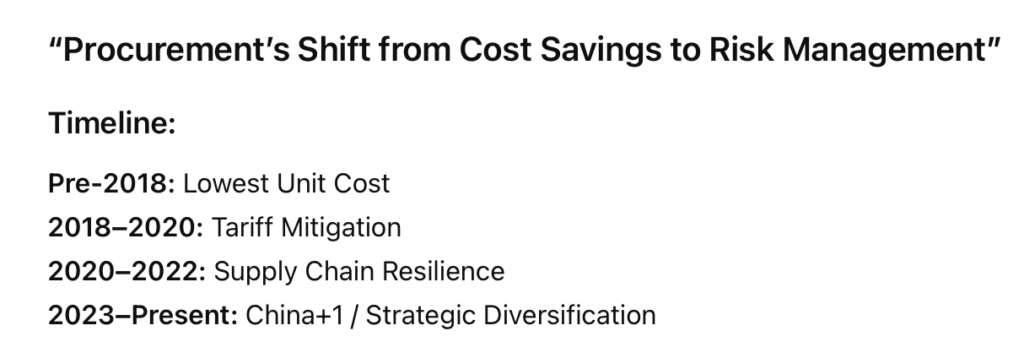
Procurement’s Shift from Cost Savings to Risk Management
Why Smart Companies Keep Running These Sourcing Exercises
To many organizations, repeated diversification efforts can feel like an expensive exercise in rediscovering that China still works.
But that perspective misses the larger strategic purpose.
These exercises often create value even when sourcing doesn’t shift.
Exploring alternative countries can strengthen supplier negotiation leverage, reduce dependency, validate backup capacity, and prepare businesses for future disruptions. It gives procurement teams optionality.
And optionality matters.
A company that has already validated suppliers outside China is significantly better positioned if tariffs rise, political tensions escalate, or logistics disruptions intensify.
In this sense, diversification work is often less about immediate migration and more about future-proofing.
The Biggest Procurement Mistake: Treating Sourcing Like a Price Spreadsheet
One of the most dangerous mistakes companies make is assuming procurement is simply a cost-comparison exercise.
It’s not.
Strategic sourcing requires understanding where products should be sourced—not just where quotes look cheapest.
Many companies underestimate supplier qualification complexity, country-of-origin implications, compliance requirements, and long-term scalability. They assume manufacturing can simply be “lifted and shifted” from China into another country with similar results.
But manufacturing ecosystems are not interchangeable.
Without proper validation, diversification can create higher costs, weaker quality, and more operational friction than staying put.
This Is Where Supply Chain Expertise Matters
The companies that succeed in modern sourcing are not necessarily the ones that move fastest out of China.
They are the ones that validate every move strategically.
That means evaluating suppliers through factory audits, compliance checks, tariff engineering, logistics analysis, HTS review, and country-fit assessments before making major sourcing changes.
This is where experienced supply chain consulting becomes essential.
At C-Solutions Group, sourcing strategy is built around protecting the buyer—not simply locating factories. That means validating supplier capability, analyzing true landed cost, and designing sourcing models that align cost efficiency with long-term resilience.
Because effective procurement isn’t about reacting to headlines or chasing the latest sourcing trend.
It’s about making informed, validated decisions that protect margins while preserving supply continuity.
The Future of Global Sourcing Isn’t China or Elsewhere—It’s Strategic Balance
For most companies, the smartest answer is not “leave China” or “stay in China.”
It’s understanding where China continues to offer unmatched value—and where diversification strengthens resilience.
For many businesses, the future is not abandonment.
It’s balance.
China for scale.
Diversification for flexibility.
Validation for protection.
That is the real evolution of procurement.
Because in modern supply chains, the lowest cost today is not always the smartest strategy for tomorrow
Recent Comments